Bayanbat
4th-year IT student at the National University of Mongolia. Building modern web experiences.
About me
I'm Bayanbat, an Information Technology student at the National University of Mongolia. I'm passionate about building polished, performant web applications.
I have a strong foundation in frontend technologies like React and Next.js, along with experience in backend development with Node.js, database management with SQL, and languages like TypeScript, Java, and C/C++. I enjoy solving problems with logical thinking and am always eager to learn new technologies.
Experience
Work
- 2024 — Present
Web Developer (Personal Projects)
Freelance / Personal Projects
Designing and building web applications with Next.js, TypeScript, and Prisma — including the eSIM Store e-commerce platform with QPay payment integration.
Education
- 2023 — Present (4th year)
B.Sc. in Information Technology (in progress)
National University of Mongolia
Studying software development, data structures and algorithms, databases, and web technologies.
Projects
Production
Live apps with real users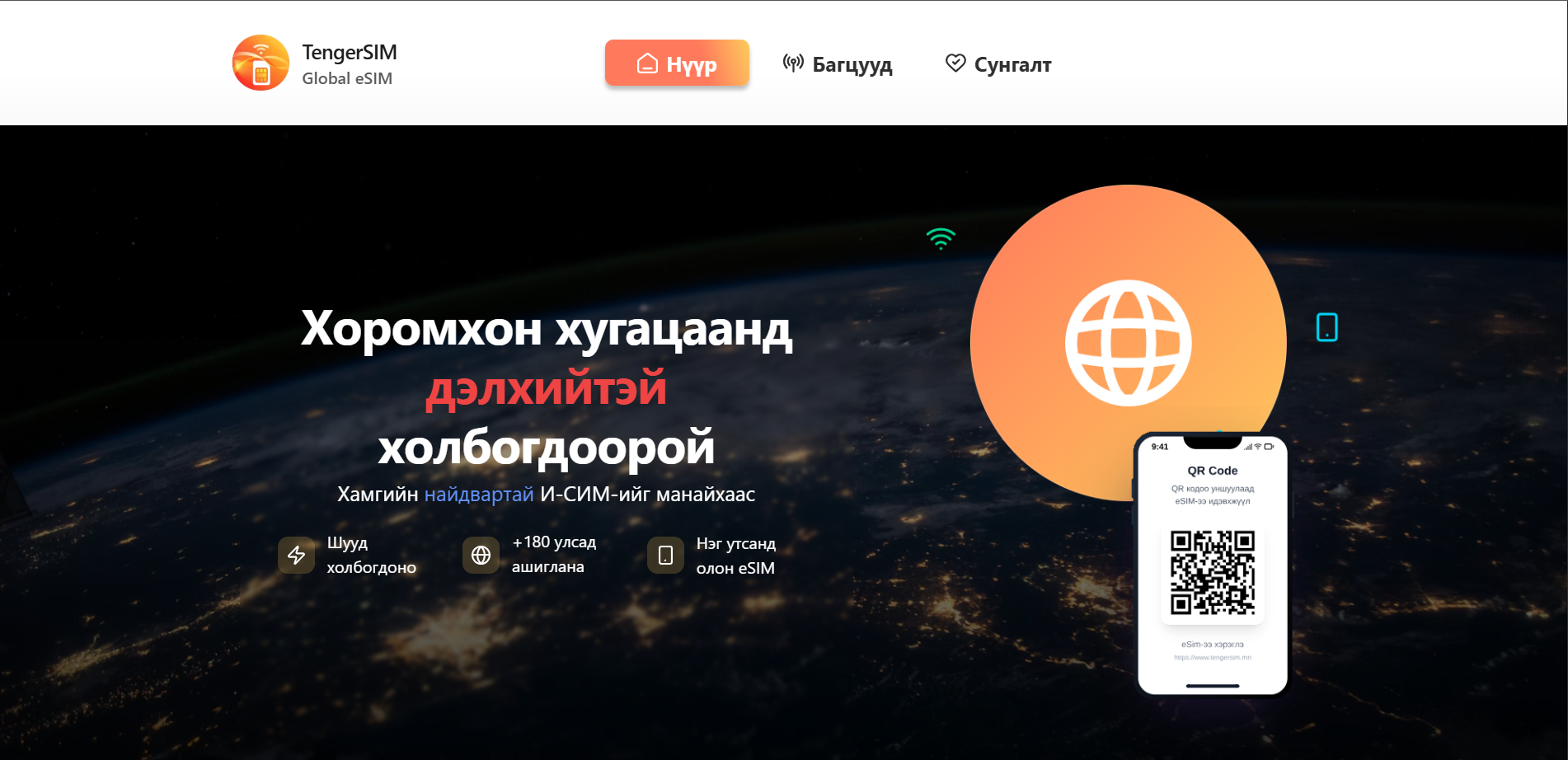
eSIM Store
A live e-commerce platform for eSIM plans with daily active users, built with Next.js 16, TypeScript, Prisma, and QPay payment integration. Handles plan browsing, checkout, and order management end-to-end.

Elivion
2026A one-page freelancing-service website with a striking animated hero, built from a Figma design using React, Vite, Tailwind CSS 4, Motion, and Radix UI.
Experiments
Things I built to learn & for fun
Anime Web
2024A React + Vite streaming UI styled with TailwindCSS, faithfully following the StreamVibe Figma design system.

Pet Clinic Management
2023A web app with Firebase Auth featuring user registration, login, pet registration, search, and appointment scheduling.
Research
Studying Text CAPTCHA Vulnerability with Deep Learning
A comparison of CNN, MobileNetV2, and CRNN+CTC architectures
Текстэн CAPTCHA-ийн эмзэг байдлыг гүн сургалтын аргаар судлах: CNN, MobileNetV2, CRNN+CTC архитектурын харьцуулалт
I trained and compared five deep-learning schemes — a custom CNN, two MobileNetV2 variants, and a CRNN+CTC sequence model — on identical data and the same CPU-only environment. The key finding: a simple CNN trained on just 772 real images broke 46.58% of full CAPTCHAs, while the more sophisticated transfer-learning and sequence architectures failed. CAPTCHA's vulnerability is architecture-independent — the real risk is that anyone can train a basic CNN, no GPU required.
Full CAPTCHA accuracy from a simple CNN
Real training images (CPU only, no GPU)
Architectures compared head-to-head